TL;DR
- The American Association of Orthodontists recommends every child see an orthodontist by age 7, even if nothing looks “wrong” yet.
- Early evaluation doesn’t mean early braces. It means I can catch issues while they’re still easy to address.
- Here are 8 signs to look for and what they could mean for your child’s smile.
As a parent, you probably spend a lot of time watching your child grow: new teeth coming in, baby teeth falling out, and a smile that seems to change every few months. But how do you know when something is worth a closer look?
I wanted to put together some of the common reasons you might want to get your child evaluated. The truth is, most parents wait until there’s an obvious problem before scheduling an orthodontic evaluation. But by then, some issues can take longer or be more involved to treat. I believe in getting ahead of concerns, not just catching up to them.
I see a lot of children from the Madison and Huntsville area, especially kids from Rainbow Elementary School, who are so close to my office. I also work closely with Treehouse Children’s Dentistry in Madison and many other local dentists, and we tag team to make sure your child has the best smile.
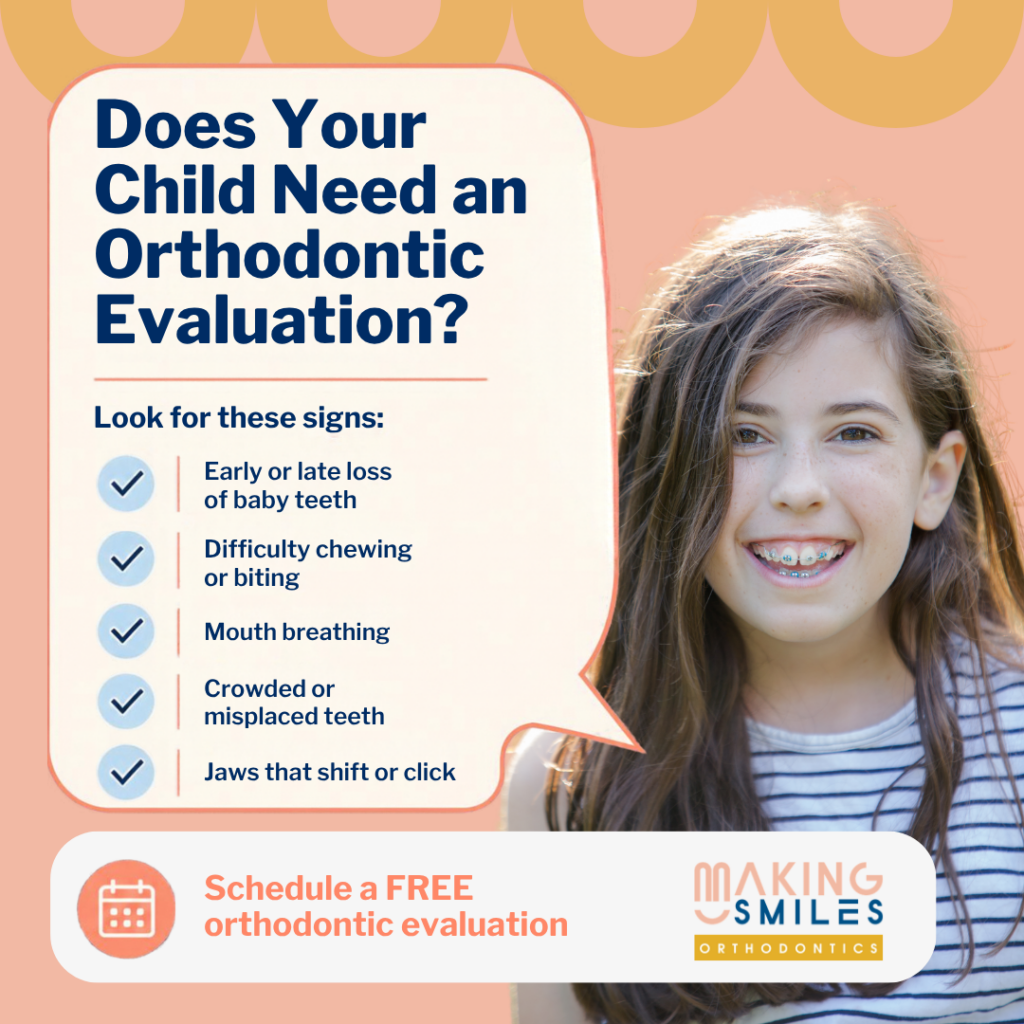
So, here are 8 signs your child may benefit from an orthodontic evaluation sooner rather than later;
Visual Alignment Warning Signs
1. Crowded or Gapped Teeth
If your child’s teeth don’t seem to have enough room to grow in straight, or if gaps persist as adult teeth come in, that’s worth paying attention to. Crowding and spacing issues don’t always resolve on their own, and early intervention can guide teeth into the right position before the jaw finishes developing.
2. Overbite
An overbite is when the upper front teeth overlap the lower front teeth significantly. A small overbite is normal, but when it’s pronounced, it can affect how your child chews, speaks, and even how their jaw develops over time.
3. Underbite
An underbite is the opposite: the lower teeth sit in front of the upper teeth when your child closes their mouth. Underbites are worth catching early, because while the jaw is still growing, there may be more treatment options available. That’s one reason an early evaluation can be so helpful.
4. Crossbite
A crossbite happens when some upper teeth sit inside the lower teeth rather than outside. It can affect just one tooth or several, and if left untreated, it can lead to uneven jaw growth and wear on the teeth.
Functional & Developmental Signs
5. Thumb Sucking Past Age 4
Thumb sucking is completely normal in younger children, but when it continues past age 4, it can start to affect how the teeth and jaw develop. If your child is still in this habit, it’s a good idea to bring it up at their evaluation so I can assess any impact.
6. Mouth Breathing
If your child consistently breathes through their mouth, especially while sleeping, it can be a sign of airway issues that also affect jaw and facial development. This one often gets overlooked because it doesn’t look like a “teeth” problem, but it absolutely belongs in the orthodontic conversation.
7. Losing Baby Teeth Too Early or Too Late
Baby teeth act as placeholders for adult teeth. When they fall out too early, neighboring teeth can shift and crowd the space. When they linger too long, they can block adult teeth from coming in properly. Either pattern is worth monitoring with a professional eye.
8. Difficulty Chewing or Biting
If your child avoids certain foods, chews on one side only, or seems to have trouble biting into things, it may point to a bite alignment issue that’s more than just a preference. This is one of those functional signs that parents often chalk up to picky eating, but it’s worth a conversation.
What Happens at an Evaluation?
Here’s the most important thing to know: an evaluation is not the same as starting treatment. I take a comprehensive look at your child’s teeth, jaw, and overall development. From there, I might recommend treatment, monitoring over time, or simply a plan to watch and wait. The American Association of Orthodontists recommends a first visit by age 7, not because every 7-year-old needs braces, but because that’s when the right information becomes available to make smart decisions.
Early evaluation gives me the opportunity to intervene at the ideal time, which often means simpler treatment, shorter treatment time, and better long-term results. So, don’t wait for the obvious signs.
Ready to Schedule Your Child’s Evaluation?
If any of these signs sound familiar, the next step is simple. Schedule a complimentary consultation with me and get a clear picture of where your child’s smile stands today and where it’s headed.
My office is conveniently located right behind Starbucks on Hwy 72 in Madison, or you can schedule an appointment online.
📍 Making Smiles Orthodontics, 7771 Hwy 72 W, Suite B | Madison, AL 35758
📞 (256) 403-7404
🌐 makingsmilesorthodontics.com
SEO Details
Author: Dr. Sydney Simpson
SEO Title: 8 Signs Your Child Needs an Orthodontic Evaluation | Making Smiles Orthodontics
Slug: signs-child-needs-orthodontic-evaluation-madison-al
Meta Description: Is it time for your child’s first orthodontic visit? Dr. Simpson in Madison, AL shares 8 signs parents should know and why early evaluation matters.
Focus Phrase: orthodontic evaluation for kids Madison AL